

I spent most of this week down with the flu, and the market did not wait for me. QQQ failed its breakout and is back trading around $700 to $705, right where it came from. The structure still favors the bulls, with the squeeze intact and a compression pattern that has not broken. The problem is the short term, where short triggers now sit on every timeframe but one. One name is doing the exact opposite, and it is the best setup I see on the board right now. Let’s take a deeper look at the Apple squeeze trade:
The Bull Trap Is In Place On QQQ
We got the MACD shift and we got the buy trigger. Then the breakout failed. You never love to see that, and a few bulls who bought the breakout attempt are now stuck in a bull trap.
The bears have control of every timeframe but one. If price cannot get back above the 21 EMA, there is room in the short term for a flush down to the 200 SMA around $685. That is not a great combo to go for the breakout.
For now, I am keeping the December QQQ calls. If QQQ gets back above the 21 EMA with a short-term buy trigger, I will take a little nibble on more of the $700 calls.
On Tuesday, I laid out the QQQ buy signals I needed before putting cash to work. That line has not changed.
Three Losing Trades I Would Take Again
We had a few losing trades over the last 10 to 12 days, and the theme across all of them was failed breakouts.
NBIS came first. I jumped in on the squeeze buy trigger on October 6th, looking for a move into at least $275 to $280. NBIS had other things in mind. It put in an ugly failed breakout, and I dumped it on October 8th on the break below the 21 EMA. It’s never the result you want when you open a trade, though I kept the risk in check and took it off for a small loss.
DELL was next. I bought it on a squeeze and took it off for a loss on the 14th. SNOW was the third. I bought it on the trigger on the 13th and took it off two days later on the 15th.
After every losing trade, I ask myself one question. Putting the result aside, based on the indicator, the structure and the chart pattern, and following my system, would I take the trade again? If the answer is yes, it is just one of those trades that did not work. Out of every hundred trades I take, 25 to 35 are going to be like that.
Why The Apple Squeeze Trade Ranks First On The Scorecard
Apple looks amazing. It has a buy trigger on every timeframe, and a squeeze forming across six timeframes at once.
Apple Daily Chart, 10.22.2026
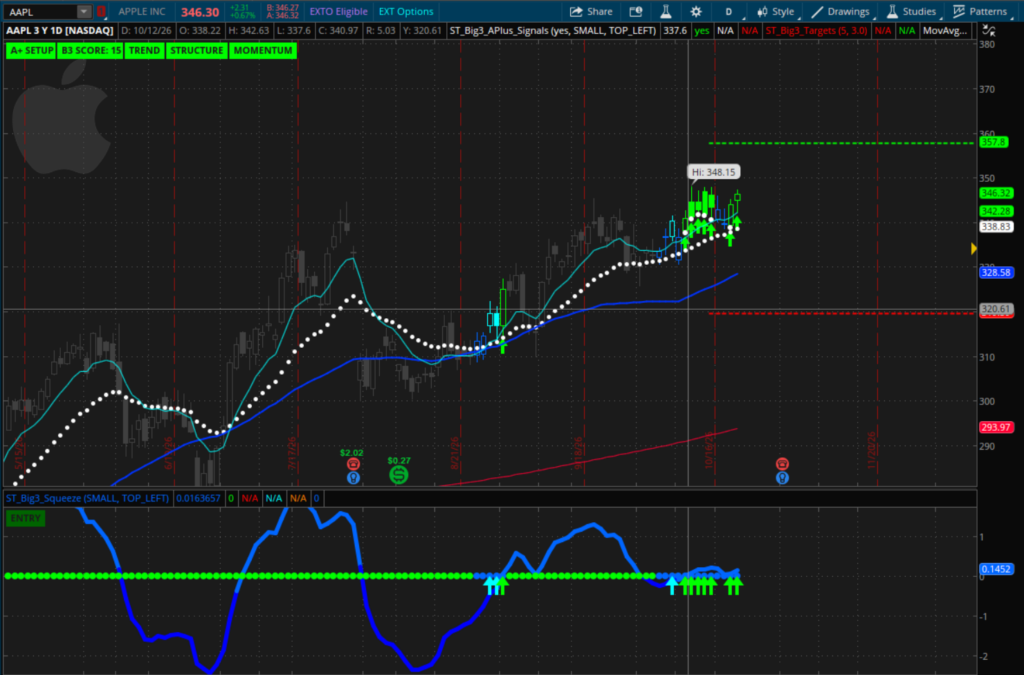
Overall, we are at market neutral, and it is a weird picture. The RSP is very bullish, the S&Ps are neutral and QQQ is a bit weaker. The good is coming from XLP, healthcare, financials, biotech and energy.
In the Big 10 basket, only two names sit at the 50% bullish threshold or better: Apple at 100 and Tesla at 50. Tesla could be a trade down the road. In the short term, Apple is numero uno.
Apple can also feed off a weaker QQQ. They are dumping Google, Microsoft, Meta and Nvidia, and for whatever reason Apple seems to enjoy all of that. Strongest name on the board, with a multi-timeframe Big 3 Squeeze and buy triggers to match. Until things change, that is the setup I like best.
How I Am Playing The Apple Squeeze Trade Into Earnings
We are long an out-of-the-money call debit spread for next week’s expiration in my room. The construction on the Apple squeeze trade is simple: defined risk on the strongest name I have.
In a normal market, you jump in here and look for a move into $355. We are not in a normal market, and Apple has earnings in a couple of weeks. So the play could just be for a move back into $350.
If the move into $350 pays, I book the profit. Then I take about a quarter of it and open something cheaper, a call butterfly or a call debit spread out of the money, to keep some skin in the game into the report. The exit plan on the Apple squeeze trade is set before price ever gets there.
Nvidia Is Still Compressing
I am also keeping the Nvidia calls. NVDA looks a lot like QQQ: a failed breakout and a pullback into the range.
Is it the picture-perfect squeeze poised to break out tomorrow? No. In a much better market, it would be 15 out of 15. I still want to give the trade more time to work, and with patience, I will look for more spots to buy pullbacks in good structure.
This compression has been going on since August, and we are now 15 to about 20 weeks in. One thing I know from experience: when that fires, long or short, it does not usually end in a tiny move. My preference is the one that takes it into $260.
The full chart walk-through is in the video above. Until QQQ gets back above the 21 EMA with a trigger behind it, I am not adding new longs anywhere else.
Stay Focused,
Taylor Horton
Jon McKeever put his method to the test with his own money on the line. Catch the replay to see how supply and demand, PMZ and Tr3ndy Precision work together before his 10-day challenge. Catch the replay here.