

The market is catching its breath this week. The bigger squeezes on my list are still fully intact, but the shorter-term charts on /NQ and /ES have gotten sloppy. I am being extra patient about adding new positions, and hanging tight with what I have. That made it a good week to book profits, and SPCX is where the most interesting ones came from. Let’s take a deeper look at the SPCX house money trade:
Last Week SPCX Was on the Chopping Block
Last Thursday I wrote about how my SPCX put credit spread was on the chopping block. Of all my open positions, it was the one at risk, and the one I was ready to cut. I drew one level, let price make the call, and put in a GTC order to buy the spread back for a profit.
SPCX ended up holding the line, and here is what happened from there.
Two Put Credit Spreads, Both Closed for a Profit
The first spread was the October $150/$145 put credit spread, sold on Friday, September 18 for $2.07. I bought it back on Friday, October 2 for $1.33, which kept about 36% of the credit.
The GTC order I mentioned last week was set at $1.00. I did not wait on it. I took the $1.33 the next morning and rolled the trade instead.
Two minutes later I sold the same $150/$145 strikes for November expiration at $1.95. Same structure, same levels, more time on the trade.
That one did not need the time. SPCX pushed into strength on Monday, October 5, and I adjusted the GTC exit order to take the profit at $1.10. That is about 44% of the credit, held over one weekend.
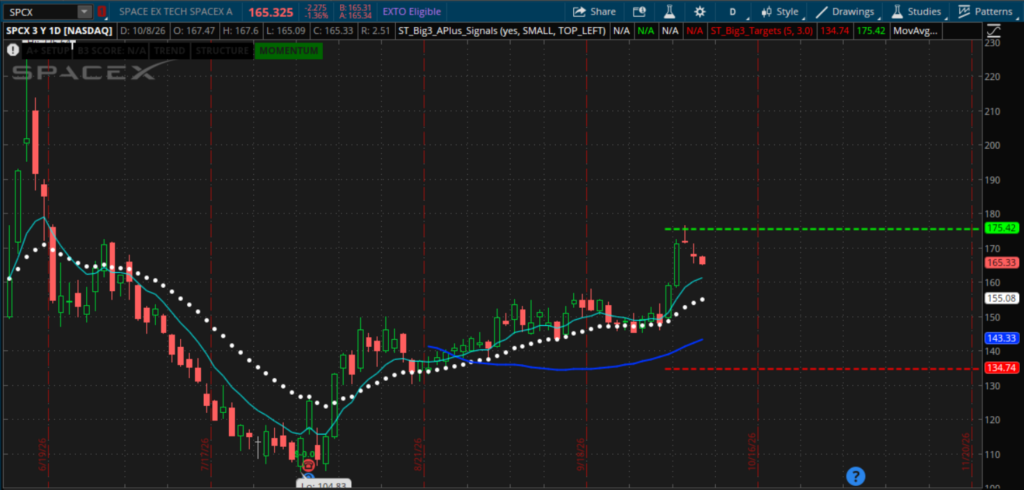
Neither spread needed a big rally. A put credit spread gets paid as long as the stock stays above the short strike, so the whole job here was SPCX holding above $150. It did that through the week it looked weakest.
SPCX, Daily Chart 10.08.26
Why I Opened the SPCX House Money Trade
Six minutes after the November spread closed, I opened a new bullish position on SPCX.
The size is the whole idea. I am risking a percentage of the profits closed on the two put credit spreads, nothing more. In the room I called it opening a shot with house money, and the percentage is up to each trader.
The plan on it is two lines: If SPCX takes out its previous highs for the year, the SPCX house money trade is positioned for a big profit. If it is a bust, the risk was already covered by the two spreads.
The structure and the entry on this one stay in the Compounding Growth Rooms while it is open. Members saw the alert the minute it went in.
The Same Playbook Is Running in ARKK
SPCX is not the only name where I did this. I booked profits on ANET and ARKK this week too.
On ANET, I closed the October $200/$195 put credit spread on Tuesday at $0.73, a quarter away from my original $0.50 target. The stock was strong, so I took the fill instead of waiting on the last piece.
On ARKK, I rolled a portion of the gains into a new position the same way I did on SPCX. Taking part of a win and putting it to work on the next idea keeps me in the names I like without putting fresh money at risk while the market chops.
Where the SPCX House Money Trade Stands Now
Last Friday, QQQ was attempting a breakout into new all-time highs, and I had no plans to fade the pop. This week the markets have come in a bit instead.
As for open positions, nothing to do for now but hang tight. MU, TSM and GOOGL are still on my watchlist, and I want the shorter-term charts on /NQ and /ES to clean up before I add anything new.
On SPCX, the level that matters now is the previous high for the year. The construction on the SPCX house money trade is as so: profits from two closed spreads paid for the risk on the new one, so a miss costs me nothing I started with.
I’m staying patient on new entries until the shorter-term charts confirm.
Stay Focused,
Taylor Horton
Earnings season brings big gaps, and most traders get caught on the first move. Watch the replay of Allison Ostrander’s free session on how she trades earnings volatility.