

SPX and QQQ gapped lower this morning, and the question I put to the room before the open was whether they survive it. Monday was all about QQQ and SMH names, with a handful of banks improving, and the Scorecard rankings had just flipped negative, which I covered in Tuesday’s QQQ Scorecard rankings breakdown. A gap lower is a real test of that bounce. I used the open to finish one trade and start another. Let’s take a deeper look at the AAPL call trade:
$350 Capped My First AAPL Call Trade
Last week I was long AAPL through a call debit spread, which I laid out in my Apple squeeze trade breakdown. On Friday morning, October 23, it popped into $350. I booked the gains on the spread at $3.20 and told the room it could keep going, or $350 could end up being resistance.
By that afternoon, $350 had proved to be resistance. I was out at the right spot, with nothing to do swing wise into the weekend, so I hung tight with my open trades and waited to see what Monday brought.
Why I Sized the AAPL Call Trade Small Into FOMC
On Tuesday morning, October 27, AAPL was setting up nicely again, so I went back in. This time it was the Friday, October 30 $350 calls at $2.22, the same $350 level that capped the first trade.
With FOMC coming, I told the room to size this one small enough to accept the max loss, and to play with some of last week’s profits if possible. A call that expires Friday can go to zero on a bad reaction to the Fed, and the size has to be able to take that before the trade does anything.
Wednesday, October 28 was quiet. AAPL did not do much through the session, so I held the position into the close and let the setup work.
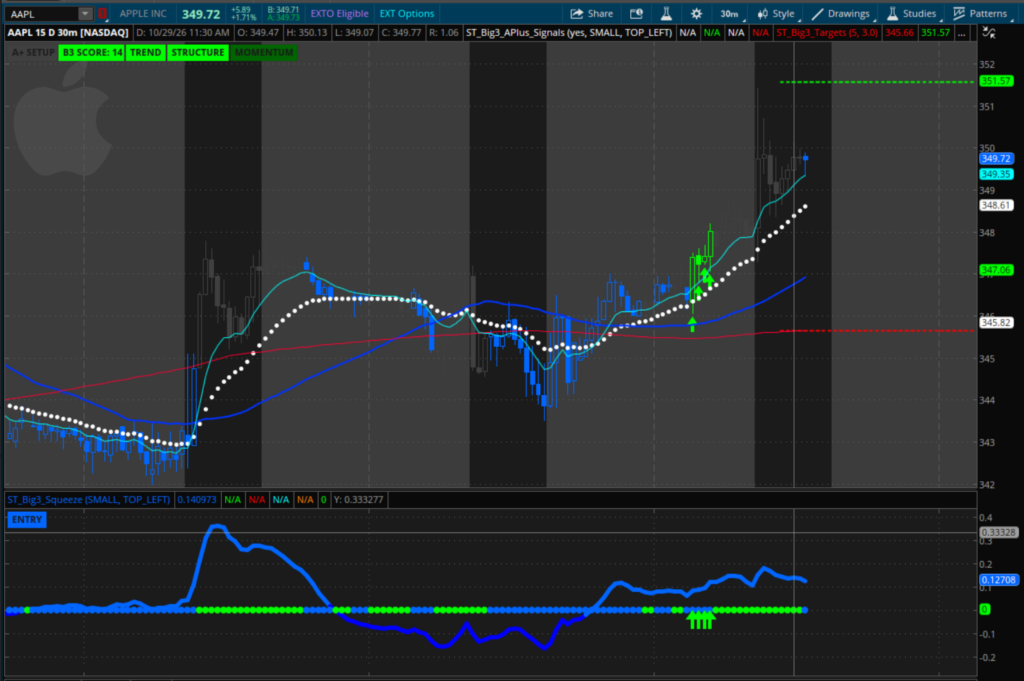
AAPL, 30 min Chart 10.29.26
Taking the Exit at the Open
This morning I sold the $350 calls at $2.46 at 8:33 a.m. CT, three minutes after the open, for a 10.8% gain on the AAPL call trade.
The exit came on a morning when futures had gapped lower, with the calls one day from expiration. The trade was sized for the worst case going in, and it closed green two days later.
An SPX Put Credit Spread Into the Gap Lower
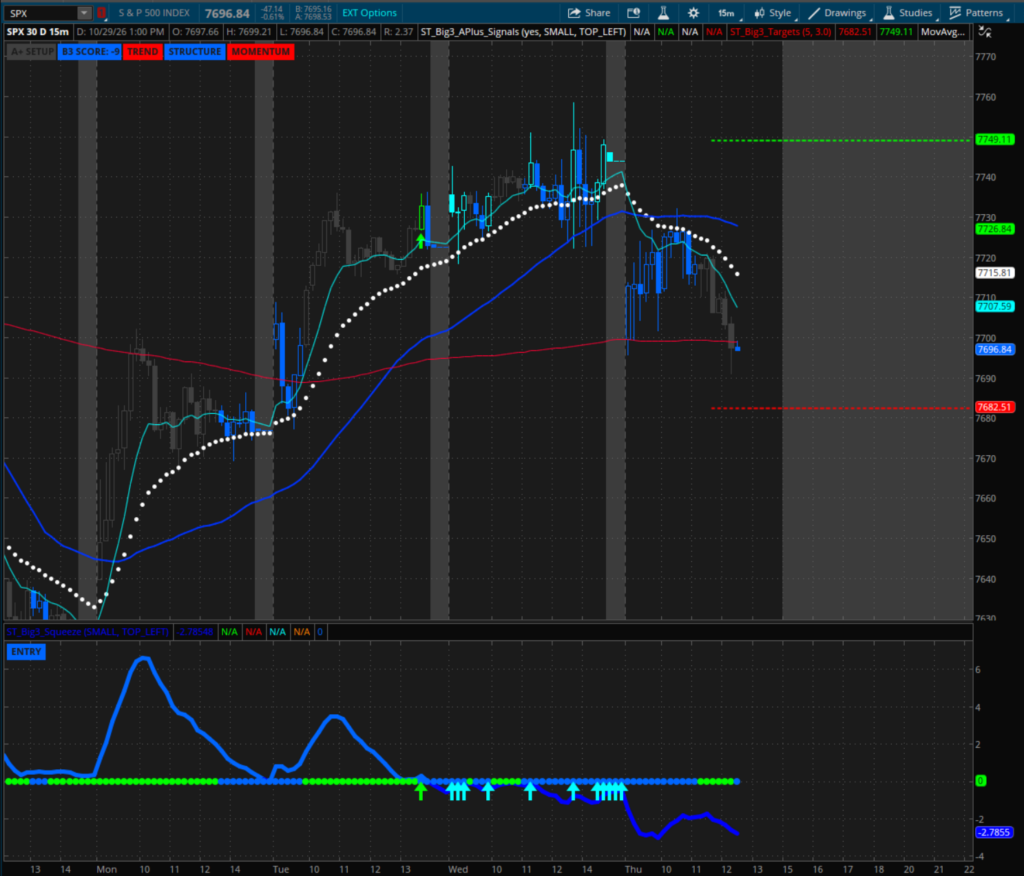
With AAPL off the board, I turned to SPX. At 9:01 a.m. CT, I sold the same day 7705/7695 put credit spread for $3.10.
The $7700 area was the level I flagged on Monday and Tuesday. It held as resistance on Monday, then held as support on Tuesday morning, with resistance around $7710 overhead. I called that a $10 box and did not see much to do inside it. A break above $7710 could lead to a nice squeeze up, and a break below $7700 could see things begin to fade.
The spread is 10 points wide, so $3.10 in credit puts the max risk at $6.90 per spread. That is a defined number, known before the order goes in, which is the same rule I used on the AAPL call trade.
Two minutes after the fill, I had a working exit order in at $1.50. It filled at 10:30 a.m. CT. Profit target hit, with $1.60 of the $3.10 credit kept, or 52%, in about 90 minutes.
SPX, 15 min Chart 10.29.26
I told the room I was looking for a few more of these through the afternoon, and that would depend on how things unfold.
Where the AAPL Call Trade Leaves Me Now
I am flat AAPL after two trades at the $350 level. If it sets up again, I will look at it again, with the same sizing rule.
I am still holding my NVDA December $200 calls. As of Monday, I thought it was too early to add, and nothing has changed that yet.
Both trades went out live in the Compounding Growth Rooms, posted as they happened.
Size every trade so the max loss is a number you can accept before you enter.
Stay Focused,
Taylor Horton
John Carter is now handing a big part of his trading process to AI. Watch the replay to see how he builds his own custom AI trading team, and why he says traders have an 18-month window before the early adopter edge is gone.